© Brighteon.com All Rights Reserved. All content posted on this site is commentary or opinion and is protected under Free Speech. Brighteon is not responsible for comments and content uploaded by our users.

Description: Cosmos Unveiled: A Beginner’s Journey Through Time and Space
Narrated video of the visual assets (2nd edition) for the book: "Cosmos Unveiled" published on https://books.brightlearn.ai/Cosmos-Unveiled-A-Beginners-Journey-Through-Time-and-17a6dcea8-en/index.html
The narrated video slides are in order and correlate to the chapters and subchapters of the book.
See "Chapters" section below for the complete narration script
Cosmic playlist: https://suno.com/playlist/8bb5f283-d67f-48df-b794-f76377c6620e
Disclaimer Notice
This companion video and book was generated with the assistance of artificial intelligence (AI) technology. While the AI has been directed to compile information from established scientific knowledge, users should be aware of the following:
The content represents a synthesis of existing cosmological theories and data as of its creation date. Cosmology is a rapidly advancing field, and new discoveries may supersede some information presented.
The AI-generated text has been structured and reviewed for educational coherence, but it may contain oversimplifications of complex concepts inherent to an introductory text.
This companion video and book is intended for educational and informational purposes only and should not be considered a sole source for academic or research work. Readers are encouraged to consult primary scientific literature, textbooks, and reputable scholarly sources for in-depth study.
© All rights reserved, Motts Media
Cosmos Unveiled: Narration Script
Chapter 1: Understanding Cosmology: The Science of the Universe
Slide 1.1: Defining Cosmology
From our earliest ancestors gazing at the night sky in wonder to today’s scientists wielding the power of mathematics and technology, the quest to understand the universe is a story of human curiosity. This image captures that epic journey. On the left, an ancient astronomer, guided by starlight and simple tools, begins to map the heavens. On the right, a modern scientist deciphers the cosmos through the language of complex equations, revealing the intricate dance of galaxies. The arrow connecting them symbolizes the unbroken chain of inquiry that defines cosmology—the science of the origin, evolution, and ultimate fate of the universe.
Slide 1.2: Key Historical Figures
Our understanding of the cosmos is built on the shoulders of giants. This montage honors three figures who revolutionized our perspective. Galileo Galilei, whose telescope revealed the moons of Jupiter, shattering the geocentric model. Albert Einstein, whose theory of general relativity reshaped our understanding of gravity as the curvature of spacetime itself. And Edwin Hubble, whose observations of receding galaxies proved that our universe is expanding, a discovery that underpins all of modern cosmology.
Slide 1.3: Fundamental Questions
At its heart, cosmology seeks to answer the most profound questions we can ask. This image represents that quest. The human eye, reflecting the vastness of a spiral galaxy, looks out at the great unknowns. Where did it all come from? How is the universe structured on the grandest scales? How has it evolved over billions of years, and what is its ultimate destiny? These are the fundamental questions that drive the science of cosmology.
Slide 1.4: Einstein’s Relativity
Albert Einstein’s theory of general relativity provides the foundation for our modern understanding of gravity. This 3D rendering visualizes his revolutionary idea. Imagine spacetime as a stretched, flexible fabric. A massive object, like a star, creates a dip or a curve in this fabric. Smaller objects, like planets, don’t fall towards the star due to a mysterious force, but rather follow the curved paths created by the star’s warping of spacetime. This is gravity—not a force, but a feature of the geometry of the universe itself.
Slide 1.5: Quantum Mechanics
On the smallest scales, the universe is governed by a different set of rules: the strange and wonderful laws of quantum mechanics. This visualization depicts the quantum vacuum, a seething sea of virtual particles popping in and out of existence. The famous double-slit experiment, highlighted here, reveals the dual nature of reality, where particles can also behave like waves, creating interference patterns that defy classical intuition. The quantum realm is the foundation of all matter and energy, and its mysteries are central to cosmology.
Slide 1.6: Tools of Cosmology
Our knowledge of the cosmos is only as good as the tools we use to observe it. This panoramic collage showcases the evolution of these incredible instruments. From the ground-based telescopes that first opened our eyes to the heavens, to the Hubble Space Telescope orbiting above Earth’s distorting atmosphere, to the magnificent James Webb Space Telescope, which peers back to the very dawn of time, each new tool has brought us closer to understanding our place in the universe.
Slide 1.7: Observations Revolutionizing Cosmology
This powerful “before and after” image illustrates the revolutionary impact of modern astronomical observations. On the left, a simple, hand-drawn sketch of a geocentric solar system, representing our limited, Earth-centered view for much of human history. On the right, the Hubble Ultra-Deep Field, an image containing thousands of galaxies, each a city of billions of stars. This single photograph reveals the true scale and richness of the cosmos, forever changing our perspective.
Slide 1.8: Role of Mathematics
Mathematics is the language of the universe. This image visualizes the profound connection between abstract equations and physical reality. From the elegant symbols of Einstein’s field equations, the very structure of the cosmos emerges—the glowing filaments of the cosmic web, the vast clusters of galaxies, all described and predicted by the power of mathematics. It is through these equations that we can begin to comprehend the universe’s grand design.
Slide 1.9: Why Cosmology Matters
Why do we study the cosmos? This image captures the answer. A diverse group of people, united in awe, look up at the brilliant tapestry of the Milky Way. Cosmology connects us to the universe and to each other. It speaks to our innate curiosity, our desire to understand our origins, and our place in the grand cosmic story. It is a journey of discovery that reminds us of the beauty and wonder of the universe we are a part of.
Chapter 2: The Birth and Structure of the Universe
Slide 2.1: The Big Bang Theory
Our universe began 13.8 billion years ago in an event we call the Big Bang. This infographic timeline illustrates that beginning. It was not an explosion in space, but rather an expansion of space itself from an incredibly hot, dense state. From the initial singularity, the universe expanded and cooled, allowing for the formation of particles, atoms, and eventually, the vast cosmic web of galaxies we see today.
Slide 2.2: Cosmic Timeline
This detailed vertical timeline zooms in on the first few hundred thousand years of the universe’s existence. From the Planck Era, a time of unimaginable energy and quantum uncertainty, the universe passed through distinct phases. The Quark-Gluon Plasma, the formation of protons and neutrons, and finally, at around 380,000 years, the era of Recombination, when the first atoms formed and the universe became transparent to light.
Slide 2.3: Cosmic Microwave Background
This is the afterglow of the Big Bang—the Cosmic Microwave Background, or CMB. This full-sky map, captured by satellites like Planck, shows the tiny temperature variations in the early universe. These minute fluctuations, seen here as red and blue patches, were the seeds from which all cosmic structure grew. The slightly denser, warmer regions eventually collapsed under gravity to form the first stars and galaxies.
Slide 2.4: Hubble’s Law
This diagram illustrates one of the most important discoveries in the history of science: the expansion of the universe. As Edwin Hubble observed, the farther away a galaxy is from us, the faster it is moving away. This is known as Hubble’s Law. The light from distant galaxies is stretched to longer, redder wavelengths, a phenomenon called redshift. This universal expansion is a key piece of evidence for the Big Bang theory.
Slide 2.5: Dark Matter
What holds galaxies together? The visible matter we see—stars, gas, and dust—is not enough. This composite image of the Andromeda galaxy reveals the answer: a vast, invisible halo of dark matter. This mysterious substance, which does not emit or reflect light, makes up about 27% of the universe. Its gravitational influence is the unseen scaffolding upon which galaxies are built.
Slide 2.6: Dark Energy
In the late 1990s, astronomers discovered that the expansion of the universe is not slowing down, but accelerating. This three-panel sequence illustrates this startling discovery. The cause of this cosmic acceleration is a mysterious force called dark energy, represented here as a pervasive purple field. It makes up about 68% of the universe and is one of the biggest mysteries in modern cosmology.
Slide 2.7: Cosmic Inventory
This pie chart reveals the startling composition of our universe. All the matter we can see—stars, planets, galaxies—makes up a mere 5% of the cosmos. The rest is hidden in the form of dark matter and dark energy. This “cosmic inventory” highlights how much we still have to learn about the fundamental nature of our universe.
Slide 2.8: Hierarchical Structure
This stunning zoom-out sequence reveals the hierarchical structure of the universe. From a single star and its planets, we zoom out to a star-forming nebula, then to a spiral galaxy containing billions of stars. Further out, we see a cluster of galaxies, and finally, the vast, filamentary cosmic web, the largest known structure in the universe. This is the grand architecture of the cosmos, built over billions of years.
Slide 2.9: Life Cycles of Stars
Stars, like living things, have life cycles. This infographic compares the fates of two different types of stars. A Sun-like star will eventually swell into a red giant, shed its outer layers to form a beautiful planetary nebula, and end its life as a dense white dwarf. A massive star, on the other hand, will die in a spectacular supernova explosion, forging heavy elements like iron, oxygen, and gold, and leaving behind either a super-dense neutron star or a black hole.
Chapter 3: Frontiers and Fate: The Future of the Universe
Slide 3.1: Accelerating Universe
This graph plots the expansion of the universe over time. After an initial burst of inflation, the expansion continued at a steady rate. But about 5 billion years ago, dark energy began to dominate, causing the expansion to accelerate. This upward curve represents the runaway expansion of our universe, a discovery that has profound implications for its ultimate fate.
Slide 3.2: Ultimate Fate
What is the ultimate fate of our universe? This triptych explores three possibilities. The “Big Crunch,” where gravity reverses the expansion, causing the universe to collapse back into a hot, dense state. The “Heat Death,” where the universe expands forever, becoming a cold, dark, and empty void. And the “Big Rip,” where the accelerating expansion becomes so powerful that it tears apart galaxies, stars, planets, and even atoms themselves.
Slide 3.3: Possible Endings: Heat Death
This moody, artistic representation focuses on the most likely fate of our universe: Heat Death. In the distant future, the last red dwarf star fades to black, leaving behind an utterly empty, cold void. It is a lonely and melancholic vision of the end of time, a universe devoid of light, heat, and life.
Slide 3.4: Inflation Theory
What happened in the very first moments of the Big Bang? The theory of cosmic inflation proposes a period of exponential expansion, where the universe grew from smaller than a proton to macroscopic size in a fraction of a second. This keyframe visualization captures that incredible burst of growth, which smoothed out the universe and stretched quantum fluctuations to cosmic scales, seeding the structure we see today.
Slide 3.5: Multiverse Hypothesis
Is our universe the only one? The multiverse hypothesis suggests that our universe may be just one of many “bubble universes” floating in a higher-dimensional “metaverse.” Each bubble could have different physical laws and properties. This conceptual image visualizes this mind-bending idea, with our own universe labeled as just one of countless possibilities.
Slide 3.6: Quantum Gravity
One of the biggest challenges in modern physics is to unite Einstein’s theory of general relativity with quantum mechanics. This abstract visualization attempts to merge the large and the small. The smooth fabric of spacetime becomes a grainy, chaotic “quantum foam” at the Planck scale, the smallest possible size. Here, the laws of physics as we know them break down, and the true nature of reality may be revealed.
Slide 3.7: Upcoming Missions
Our quest to understand the universe continues with a new generation of powerful telescopes and observatories. This futuristic montage showcases some of these upcoming missions: the Roman Space Telescope, which will map the universe in unprecedented detail; the LISA mission, which will detect gravitational waves from space; and the next-generation of giant ground-based telescopes, which will give us new eyes on the cosmos.
Slide 3.8: Unanswered Questions
For all that we have learned, the universe is still full of mysteries. This image represents the great unanswered questions of cosmology. What is dark matter? What is dark energy? What happened before the Big Bang? How can we unify gravity and quantum mechanics? These are the questions that will drive the next generation of scientists and explorers.
Slide 3.9: Humanity’s Place
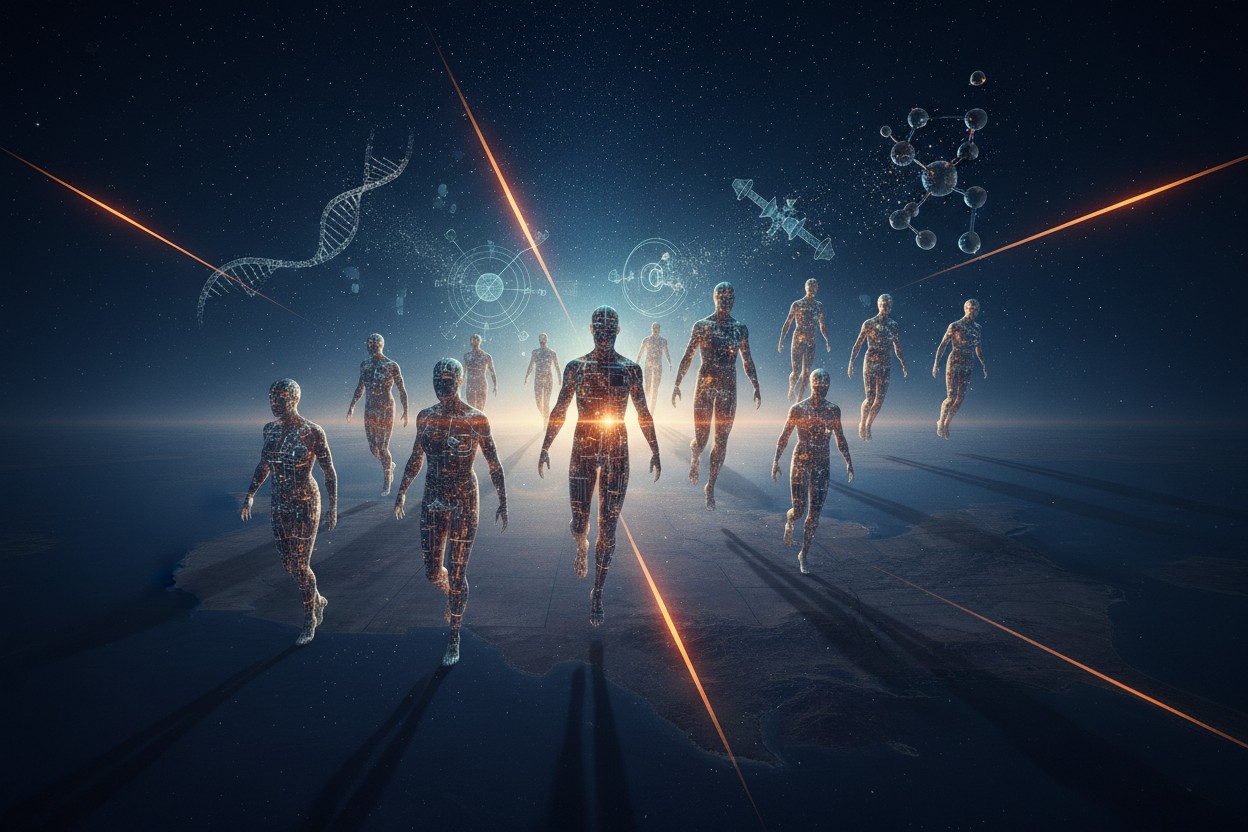
This final, hopeful image brings us back to our place in the cosmos. The iconic “Pale Blue Dot” photo, showing Earth as a tiny speck in a sunbeam, reminds us of our fragility. But from this tiny dot, lines of light and connection reach out to the surrounding galaxies and the cosmic web, symbolizing our ever-expanding understanding and our unyielding curiosity. We are small, but we are a part of this vast and wondrous universe, and our journey of discovery has only just begun.

CDC under fire for withholding critical COVID vaccine data amid transparency concerns

Study Links Prolonged Sitting to Increased Dementia Risk, Physical Activity and Sleep Found Protective

Cooking Once a Week Linked to Lower Dementia Incidence, Study Reports

The silent threat in your food: Why testing for glyphosate is more critical than ever

“Terrain: The Workshops” on BrightU: Why drinking water with meals is making you sick and fat
High-Profile U.S. Scientists Reported Dead or Missing Over Three-Year Period
